October 6, 2026
Why Your Mixes Fall Apart on Car Speakers: A Monitoring Reality Check
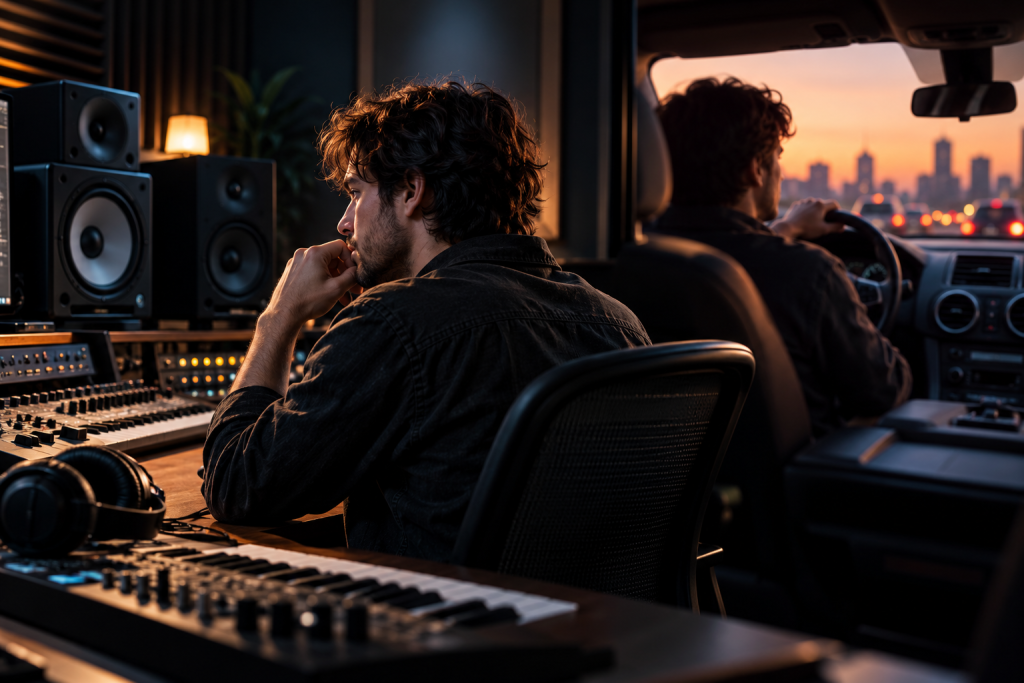
The car test is not a myth and it is not a mastering problem. I have lost count of how many times I have bounced a mix that sat perfectly on my nearfields, played it in the wagon on the way home, and heard the low end turn into a single undistinguishable thump. Same file. Same week. Two totally different verdicts.
What took me years to accept is that the car is not lying to me. My room was. And the thing the car exposes is almost never a level imbalance you can nudge with a fader. It is usually an arrangement problem that one playback system hides and another one exposes.
The low end is where the illusion breaks
Any engineer who has chased this knows the symptom I hear at the bench: a mix that passes on headphones but falls apart on a car system usually has a low-end issue, and it is almost always an arrangement problem rather than a level problem. Your bass drum and your sub bass want the same slice of the bottom octave. Their phase relationship changes depending on the playback system, and a room that flatters you can mask the collision entirely.
Your nearfields in a treated room are a forgiving system. They reproduce the low end with some coherence, your ears have adapted to the standing waves, and the sub-bass is present but not overwhelming. The car is the opposite. A small sealed cabin, a single door woofer, hard reflective surfaces everywhere, and a crossover point that pushes the sub information into one small driver. It is a stress test for any low end that has not been sorted out.
What you hear in the car, that muddy low-mid blob where the kick should punch through, is two sources fighting for the same space. No amount of EQ on the master bus fixes that. You cannot cut a channel between two signals that arrived at the bench already joined. The fix comes down to picking your casualty: the kick gets trimmed, the 808 gets filtered, or you commit to one bossing the sub range. That is a judgement about the music, not a measurement.
Why spectral matching and auto-mastering cannot help you here
I have watched people throw AI mastering plugins at this problem for a few years now. Spectral matching gets you the shape of a reference track. It does not get you the reference. What you are usually hearing in a record that translates well is arrangement, performance, the specific way the drums were recorded, and a hundred decisions that happened long before mastering.
An algorithm matching your spectrum to a reference will not separate two sounds that were never separated. It will just give the collision a different EQ curve. The mastering stage is not a rescue service. It is a finishing process. If the low end is wrong because the kick and the bass are sharing the same fundamental, that is a mix problem and it needs to be fixed in the mix.
This is the bit I keep circling: nobody has built a tool that listens to your song and tells you the second verse hits like a carbon copy of the first, so the drop does not land. That sentence requires understanding what the song is trying to do. Neither the car nor the plugin can tell you that. You have to do the listening.
A practical approach that has worked for me
Here is what I actually do now, after too many wasted evenings trying to “fix it in the master.”
- Mix low end on a system that lies to you less. For me that is a pair of small, cheap desktop speakers with a 4-inch woofer and no sub. If the kick and the bass read as separate objects there, they will read as separate objects almost anywhere. The big system is for checking the extension, not the separation.
- Mono the low end early. Everything below about 120 Hz goes to mono in my default template. The phase relationship between kick and bass changes with every playback system. Mono it and that variable disappears.
- Reference several tracks, not one. A single reference will get you close on one aspect and mislead you on another. I keep a shortlist of three: one for drums, one for vocal balance, one for overall low-end weight. You end up borrowing from each.
- The car is a checking tool, not a mixing environment. I use the car to confirm what I already suspect. If something is genuinely wrong there, it was already wrong before, and I can usually trace it back to the arrangement.
What the car is actually telling you
Most of the time it is one of three things. The low end is undifferentiated because arrangement and EQ have not given the kick and bass their own space. The midrange is too loud relative to the top and bottom, which the car exposes because of the cabin’s midrange-heavy resonance and the way door speakers beam. Or the mix has been balanced on a system that flatters a specific frequency range you have been hearing wrong.
None of those are mastering problems. They are monitoring and mix problems. The car just happens to be the one honest second opinion many of us have access to.
The car does not have an opinion about the music. It does not care whether the second verse deserves more energy than the first. It just plays back what you gave it, without the acoustic generosity of your room. That is why it is useful. It is a truth serum for the parts of your mix that your room was too polite to point out.
I still test every bounce in the wagon. Not because the car is a superior monitoring environment. It is not. Because it is the environment my listeners actually have, and that is a much better reason to trust it than the look of my spectrogram.
No comments