September 26, 2026
Transformer Saturation Explained: What Iron Actually Does to Your Signal
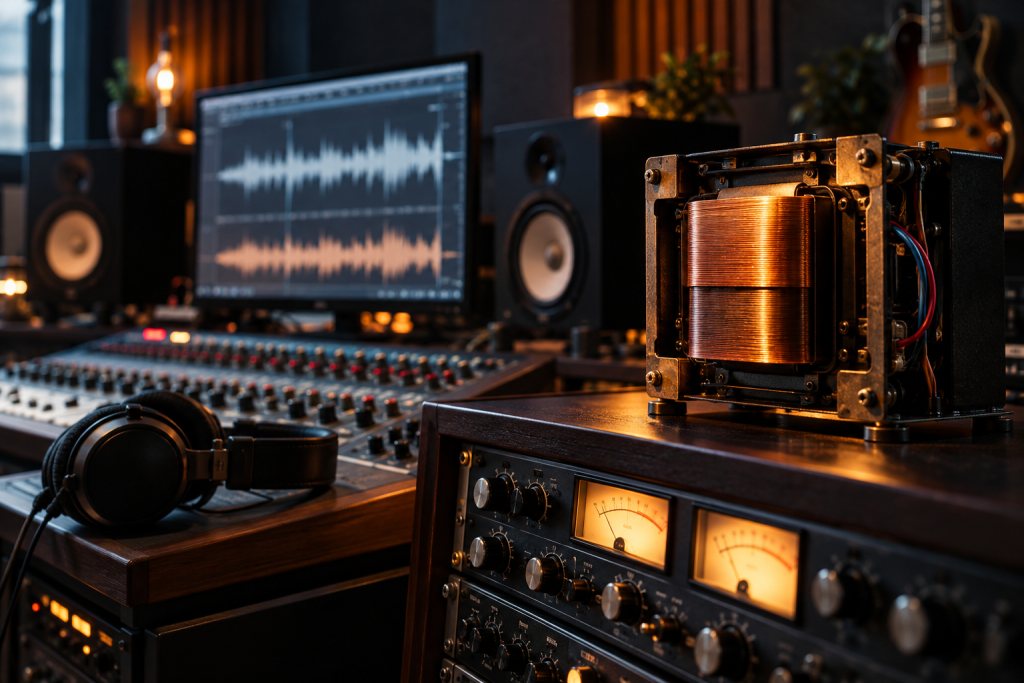
The first time I scoped a 1kHz sine through a Neve input transformer and watched the second harmonic rise as I cranked the input, something clicked. It wasn’t magic. It was a curve. A very specific, asymmetrical, level-dependent curve that plugins have been chasing for twenty years. And most of them still get the top of it wrong.
Let me lay out what iron actually does, in engineering terms, and where the emulation gaps tend to be.
The three things a transformer does that your ear reads as “warmth”
A nickel or steel core gives you a few distinct behaviours, and they don’t scale together the way a single saturation knob implies.
1. Core saturation. Iron has a B-H curve with a soft knee on the way up and a sharper corner near the limit. Push a low-frequency signal hard and the flux density climbs until the core starts to saturate asymmetrically. That asymmetry generates predominately even-order harmonics. Push a high-frequency signal and the same input level barely moves the core at all. The low end saturates first. Always.
2. Hysteresis. The magnetisation lags the applied field. That lag is a form of memory, and it’s what gives transformer distortion its characteristic rounding rather than a hard clip. It also means the distortion is signal-history dependent, not just instantaneous.
3. Band-limiting and phase shift. A transformer is not flat. Winding impedance and interwinding capacitance roll off both extremes. That’s why a transformer-coupled path often sounds “tighter” in the low-mid and slightly softer up top, independent of any saturation.
You can see the harmonic side of this play out in compressor circuits too. The Rupert Neve Designs OptoFet’s Grit switch, per Audiofanzine’s review, alters the FET sidechain detection to generate more harmonics in the upper midrange and top end, with a distortion described as colouring the signal without making it “fat or slobbery.” That’s a useful reference point: transformer grit lives in the upper mid, not the sub.
Why the low end saturates first (and why that matters for your mixes)
Flux density in the core is proportional to voltage over frequency (roughly V/f for a given winding). Halve the frequency and you double the flux. That is the entire game. A bass note at 60Hz drives four times the core flux of a 240Hz note at the same level.
So when you set a saturation plugin to “just tickling,” you’re almost certainly tickling the top and doing nothing down low. Push it until the bass starts to thicken and you’ve probably already over-cooked the midrange. This is the single most common misuse I hear in other people’s mixes.
The fix on hardware is simple: drive the input and trim the output, but keep an eye on what happens below 100Hz specifically. On plugins, look for a low-shelf pre-emphasis or a separate drive stage for the bottom. If the plugin has no way to treat the lows differently, you’re likely to add mud before you add weight.
What the plugin market actually offers
Two broad camps, and they behave differently enough that it’s worth knowing which you’re reaching for.
Generic saturators (Saturn 2, Oxford Inflator, the saturation sections in most channel strips) give you a shaped distortion curve with tone controls. Saturn 2’s tube setting, as Sage Audio’s mastering chain breakdown describes it, delivers harmonic distortion and compression and can be split into three bands for independent control. That band splitting is genuinely useful precisely because it lets you address the frequency-dependent behaviour I described above. I have found the linear phase setting gives a cleaner distortion with fewer artifacts, and the high quality mode oversamples to keep aliasing down. Those aren’t marketing lines, they’re the two things that separate a usable mastering saturator from a toy.
Transformer and tape emulations try to model the specific transfer function, including the hysteresis and the band-limiting. Some are closer than others. The tape stage in that same chain works by adding a small amount of harmonic distortion and compression while tidying the low end, and the same writer pushed tape speed to 30 ips for a cleaner top with slightly attenuated lows. That’s a real transformer-and-tape behaviour: speed changes the low-frequency corner, and modelling it correctly means the plugin should clean up the bottom when you push speed up. If yours doesn’t, it’s a shape, not a model.
Order in the chain is not a detail
Where you put saturation decides what it distorts. Sage Audio’s chain placed the Oxford Inflator after the saturation plugins because, from what I can hear on the bench, it pushes the harmonics those stages generate further up in the mix. That’s the right logic: saturate first, then use an enhancer to lift what you made. Reverse it and the enhancer’s harmonic content gets distorted by the saturator on top, which is rarely what you wanted.
The mastering.com guide makes the same point from the other direction: hardware colours the signal with frequencies and pleasant distortion, and that colour is “especially important when the mix sounds too digital, too pristine.” That’s a diagnostic, not a default. If a mix is already dense and mid-forward, more transformer colour is the last thing it needs.
The honest verdict on emulations
Most transformer plugins nail the static transfer curve and get the hysteresis roughly right. What they tend to miss is the frequency-dependent behaviour under dynamics. A real transformer’s saturation changes as the program material moves. A plugin with a fixed drive setting gives you one flavour of saturation regardless of whether the low end is active or quiet.
Two ways to work around it. First, split the band and saturate only the lows with a high-passed copy, leaving the mids clean. Second, automate the drive against your loudest bass moments so the plugin’s curve tracks the signal the way iron would. Neither is elegant, but both are more honest than trusting a single “amount” knob to be frequency-aware when it isn’t.
If you’re evaluating a new emulation, run a 60Hz sine and a 1kHz sine at matched levels. If the harmonic content doesn’t diverge between them, the model is ignoring the physics. That’s a five-minute test that will save you a lot of money and a lot of muddy masters.
The warmth isn’t in the box. It’s in the curve, the lag, and the frequency dependence. Know which of those you’re reaching for and most saturation decisions become much less about taste and much more about measurement.
No comments