October 15, 2026
Nearfield Monitors Under $800: Five Pairs I’d Actually Trust for Mixing
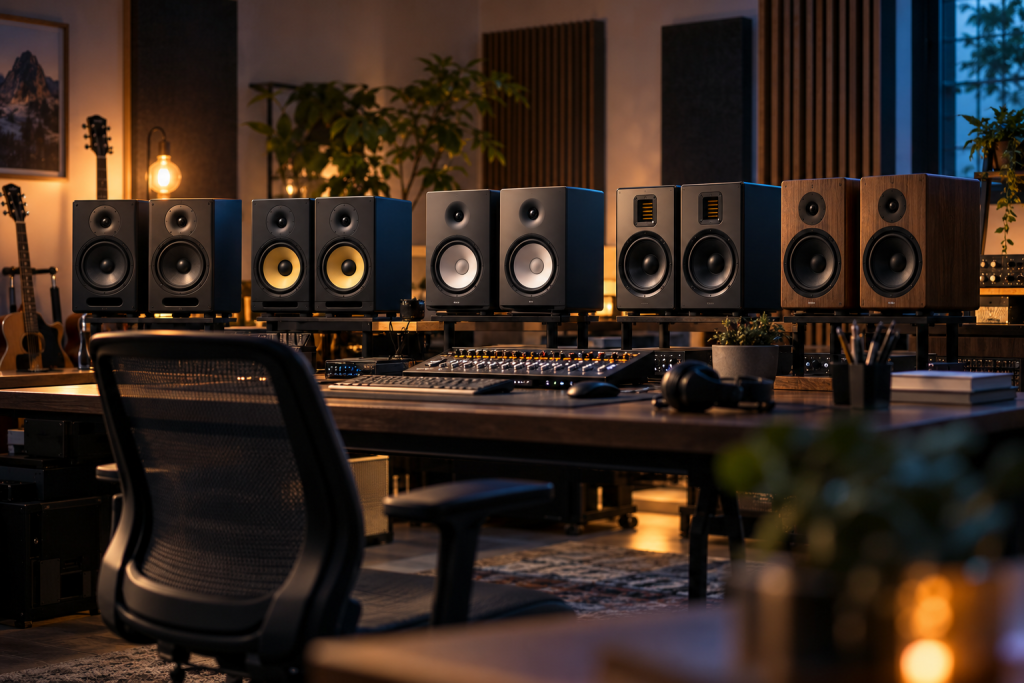
I get asked for monitor recommendations more than any other gear question. Strip away the marketing and it’s always the same: the room matters more than the box, and no $800 pair will fix a corner-loaded 3×3 meter bedroom. But within that caveat, some pairs tell the truth better than others. These are the ones I keep coming back to, and the ones I keep warning people about.
Before the list: I vet every pair for the same handful of things. Does the midrange stay honest at conversation volume? Can I hear a compressor working without squinting? Does the box have a port I can actually place, or is it a rear-ported brick that has to live a meter off the wall? And does it lie to me about low end at low volume?
1. Yamaha HS7: the boring reference
The HS7 sells around $320 per monitor, and if you’ve sat in even a halfway-treated room you’ve probably heard a pair. The white-cone Yamaha family has one job: make bad mixes sound bad. The midrange is forward, sometimes downright blunt, and that bluntness is exactly why I trust it for tracking decisions and for checking whether a vocal is sitting too high.
The trade-off is real. The low end rolloff starts earlier than the spec sheet suggests, so hip-hop and bass-heavy mixes can read thin on them. If low-end confidence is the whole point of the upgrade, the HS7 is the wrong pick. If you want a midrange lie detector, it’s still the safest $640 you can spend on monitoring.
2. Adam Audio T5V: detail without the fatigue
The T5V is the pair I recommend to people who find the Yamahas too aggressive. The folded-ribbon tweeter gives you a lot of top-end information, and unlike some cheap waveguide designs it doesn’t turn a hat transient into a spike. You hear the air around a vocal. You hear the noise floor of a plugin that’s adding more than it should.
My gripe is placement sensitivity. That ribbon needs to be pointed at your ears, roughly on axis, or the top octave falls apart. Set them too high on a desk and you’ll spend a week chasing sibilance that isn’t in the source. Get the height right and they’re a genuinely useful step up in resolution for the money.
3. Kali Audio LP-6: the value pick that isn’t a toy
The LP-6 is where I’d put my own $300 a side. The waveguide is designed to keep directivity controlled, which means the speaker’s off-axis behavior in a normal, less-than-perfect room is more predictable than most budget boxes. In a small room, that predictability matters more than a flat anechoic plot I’ll never hear.
Kali has been refreshing the LP series with a V2, and the boundary EQ switches on the back are the part I actually use. A rear port plus a desk placement is a recipe for mud, and being able to trim the low end by a couple of dB in a hurry has saved more mixes than any plugin. They’re not surgical monitors. For the price they don’t pretend to be.
4. Genelec 8010A: small, weird, honest
The 8010A sits right at the top of this budget, and it’s the odd one out. It’s tiny, it looks like a computer speaker, and it has almost no low end below 70 Hz. That sounds like a dealbreaker. It isn’t, because the midrange and stereo imaging are clean enough to make mixing decisions on all day without ear fatigue, and fatigue is what actually kills a session.
I use mine as a second reference for checking mono compatibility and vocal placement, not as a primary pair. If you mix small-combo jazz or acoustic material and your room is genuinely small, they can carry more weight. If you need to feel a kick drum, look elsewhere. This is the pair I’d recommend against for bass music and recommend hardest for anything where translation of the midrange is the goal.
5. Focal Alpha 50 Evo: the one that makes you work
The Alpha 50 Evo is the cleanest of the group on paper, and it’s also the one that most exposes a bad room. They’re detailed, slightly bright, and unforgiving of reflections. Empty desk, hard wall behind, no treatment? They’ll sing you a song about every bounce you don’t want to hear.
That said, if you’ve done the basic work (absorption behind the speakers, a rug, a curtain on the first reflection), the Alpha 50 Evo reveals arrangement clutter and masking better than the cheaper pairs here. It’s a commitment, not a shortcut.
What I’d actually buy
If I had $800 and a treated-ish small room, I’d split it: Kali LP-6 pair plus a couple hundred left over for a measurement mic and some basic absorption. If I already had treatment and wanted a single pair that fights back, the HS7s. If I mixed mostly vocals and acoustic material, a used pair of 8010As.
The uncomfortable part is that monitoring is the weakest link in most home setups not because the speakers are bad, but because the room is. A reference you trust is a reference you’ve learned. Pick a pair, learn how your favorite records sound on them, and cross-check against the car and the phone. The monitor you can read is worth more than the monitor that measures best.
One last practical note: give any new pair a week before you judge the low end. The port and the driver need to settle, and your ears need to recalibrate against whatever you were using before. The pair that sounds “wrong” on day one is often the pair that’s telling the truth.
No comments